On Wednesday morning, the government’s official inflation report showed consumer prices rose 4.2% over the past year, the hottest reading since April 2023. The same day, Bitcoin was changing hands around $61,700, down more than 13% on the week, after the big Bitcoin ETFs saw investors pull out roughly $3 billion in ten trading days. The financial press connected the dots immediately: inflation is back, war is escalating, and Bitcoin is getting dumped. Case closed, the skeptics say. Bitcoin failed the test again.
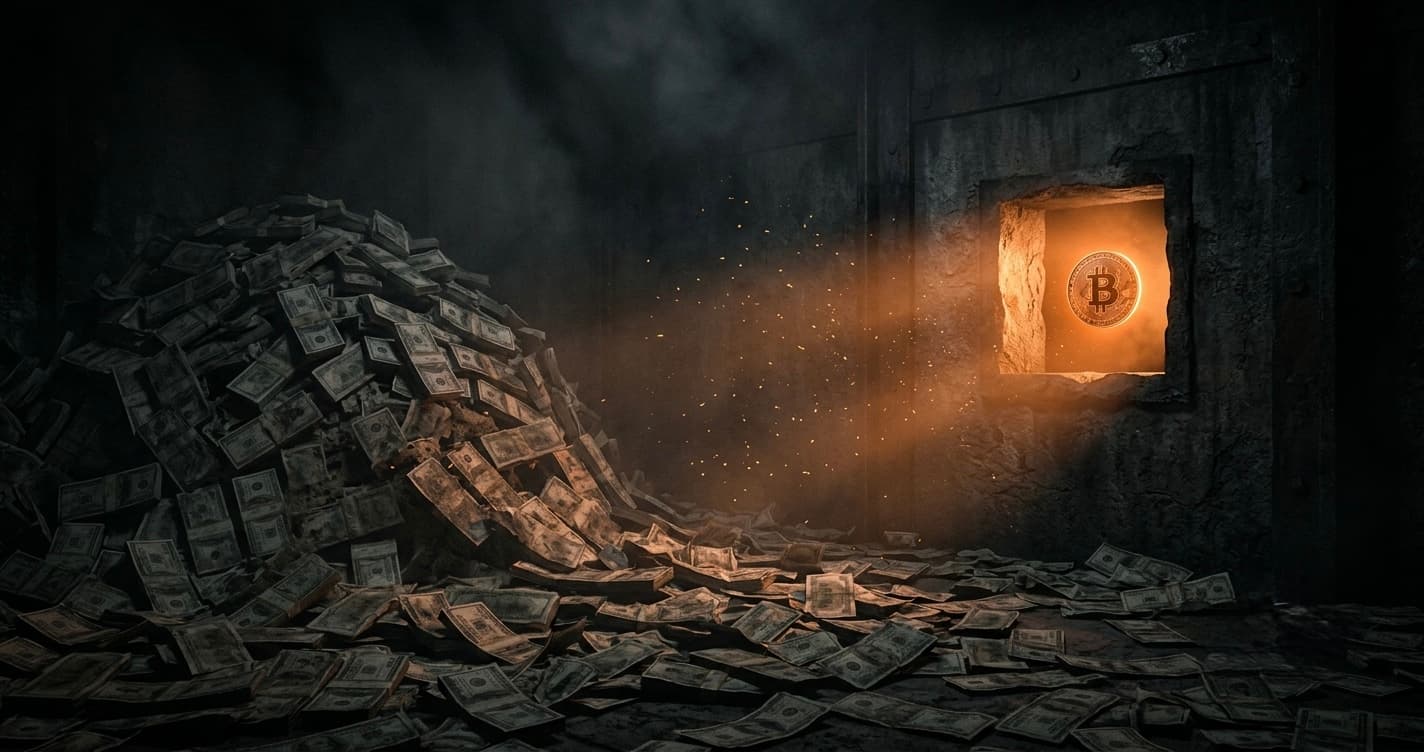
However, I think they’re grading the wrong exam. Bitcoin was never the fear trade. It’s the debasement trade. It is a bet that governments will quietly shrink the value of their currencies by creating ever more of them. And while the fear trade is unwinding in real time (look at gold, down nearly 27% from its January peak) the debasement setup just got materially stronger. The Fed is now pinned between 4.2% inflation and a $39 trillion debt load, and there is no exit from that corner that doesn’t involve printing.
The Selling Is Real. The Story Is Wrong.
Let’s not sugarcoat the flows. The U.S. spot Bitcoin ETFs saw $1.72 billion leave in the week ending June 6. This was the largest weekly exit since February 2025, capping a thirteen-day streak that drained over $4.3 billion from the funds. BlackRock’s IBIT, the biggest of them, lost $1.34 billion in a week. Four straight weeks of outflows now total roughly $5.4 billion. That’s the biggest exodus since these products launched in January 2024.
Here’s what’s interesting: the stated reason for the selling is that strong jobs data killed hopes of a Fed rate cut. When the Fed holds interest rates high, boring government bonds pay a decent, guaranteed return so money managers ask themselves why they should hold Bitcoin, which pays no interest, when they can clip 3.5% “risk-free”.
Futures markets now price the Fed’s next move as a hike, possibly in December. So the marginal ETF seller isn’t fleeing Bitcoin because the thesis broke. They’re fleeing because Treasuries pay them to wait and their performance is measured in quarters, not decades.
To see who’s on the other side of the trade, you can look at the blockchain itself. Because every Bitcoin transaction is public, analysts can watch what different groups of holders are actually doing and the most useful group to watch is “long-term holders,” wallets that haven’t moved their coins in over five months. These are the conviction buyers, not the day traders. Yes, even some of them panicked: long-term holders sold at roughly $2.4 billion in losses in a 48-hour window in early June. People dumping at a loss is what capitulation looks like, and capitulation is what bottoms feel like. But zoom out and the picture flips. The total stash held by long-term holders has grown from 14.12 million BTC at October’s $126,000 high to 16.3 million BTC today, and they added nearly 500,000 BTC in the past 30 days, the largest monthly accumulation since May 2025.
The Fed’s Impossible Math
Now to the part the rate-cut crowd is missing. May’s inflation didn’t just come in hot. It came in hot for a reason the Fed cannot fix. Energy prices jumped 3.9% in a single month and are up 23.5% year over year, driven by a war in the Persian Gulf that has oil trading near $94 a barrel. Strip out energy and food, and “core” inflation, the measure the Fed watches to judge underlying price pressure, actually looked tame at 2.9%. The Fed can’t drill for oil and it can’t de-escalate the Strait of Hormuz. But it also can’t ignore a 4.2% headline number, which is why the June 17 meeting will almost certainly hold rates at 3.50%–3.75% and why traders have started whispering about a hike.
Here’s why this matters: the federal government cannot afford the cure. The textbook response to inflation is higher interest rates. But the government is the world’s biggest borrower, and higher rates raise its own borrowing costs. The national debt hit $39.2 trillion on June 3 and is on pace to cross $40 trillion by late September. A trillion dollars of new debt gets added roughly every 141 days. Just the interest on that debt now runs $1 trillion a year, about 14 cents of every dollar the government spends. Last month, the Treasury had to offer a 5% yield to sell its 30-year bonds which was the first time it’s paid that much since 2007 and demand was still described as “tepid.” Think of it as a borrower whose credit card rate keeps getting raised because lenders are getting nervous. And the official budget forecasts project the government will overspend by more than $2 trillion a year through 2036.
Put those two facts side by side. Inflation argues for higher rates. The debt argues that higher rates are fiscally lethal because the government’s old debt was borrowed at an average rate of just 3.39%, and every time a chunk of it comes due, it gets refinanced at today’s higher rates, ratcheting the interest bill up.
Economists have a name for the endgame: fiscal dominance. It means the central bank stops setting interest rates to fight inflation and starts setting them to keep its own government solvent. When that constraint binds, and it is binding now, one weak bond auction at a time, the historically consistent release valve is the same one it’s always been. You don’t default. You don’t cut spending in an election year. You debase: you let inflation quietly shrink the debt by shrinking the value of the dollars it’s owed in.
Gold Already Told You How This Ends
Gold ran to an all-time high of $5,595 in late January, when the Iran conflict was at peak uncertainty. Today it sits around $4,0800, down 27% from the top, even as the actual shooting resumed this week. The fear premium is bleeding out, because fear premiums always bleed out. Wars de-escalate, ceasefires get signed and the panic bid goes home.
Gold is what you buy when you’re scared of a war. Bitcoin is what you buy when you think the government’s response to the war is going to debase the currency. The war added a 23.5% energy shock to the inflation numbers. The government’s response will be to keep borrowing $2 trillion a year and lean on the Fed to keep that borrowing affordable. One of those is temporary. The other is structural.
The market is currently pricing Bitcoin off the temporary story: risk-off, rate-sensitive, sell first and ask questions later, while the structural story compounds quietly underneath it. And this is where Bitcoin’s one unbreakable rule matters: there will only ever be 21 million coins, written into the software itself, with no committee that can vote to print more. A fixed supply doesn’t care whether the Fed’s next move is a hike or a cut. It cares that the pile of dollars keeps growing, and $39 trillion on its way to $40 trillion is the pile growing.
What I’m Watching
The June 17 Fed meeting comes first, and it’s Kevin Warsh’s first as chair, sworn in on May 22 after the narrowest confirmation vote in the Fed’s history. I’m not really looking at the decision, because a hold is nearly certain, but at the language. If the new chair acknowledges that the inflation spike is mostly an oil story and chooses to look through it, that’s the first soft signal that fighting inflation now takes a back seat to keeping the government funded. If they talk tough about hikes instead, watch long-term bond yields: the 10-year Treasury has lived in a 4%–4.5% band since March, and a sustained break higher would put the $1 trillion interest bill on the front page, where it belongs.
Second, the Iran ceasefire. This week’s strikes show how fragile the tentative 60-day extension is, but if it gets signed and holds, oil falls, headline inflation cools into the fall, and the “Bitcoin failed as an inflation hedge” crowd will quietly rotate to a new critique, even as the deficits that war spending deepened stay on the books permanently.
And third, the thing almost nobody is paying attention to: private credit. Over the past decade, big investment funds quietly took over a job banks used to do — lending money to companies. The difference is that banks have regulators looking over their shoulder, and these funds mostly don’t. The industry has grown to nearly $2 trillion, and here’s the uncomfortable part: because these loans are private, nobody really knows what they’re worth until someone is forced to sell one. In May, global regulators issued a formal warning about exactly that. But it gets worse. The banks aren’t actually out of the picture, because they lend billions to these funds. So if the funds get in trouble, the banks get in trouble too, and even the Fed’s own top regulator has admitted they can’t fully see how deep those connections go.
The early warning signs are already flashing. Bank stocks are down about 15% from their high this year and just last week, one of the sector’s flagship funds reported a surge of investors asking for their money back. That’s how these things start: not with a crash, but with a line forming at the exit. And if that line turns into a stampede, we know exactly what the Fed will do, because it’s what the Fed always does when the financial system cracks. It will flood the system with money. That’s the debasement trade arriving on schedule.
So here's the whole picture in one breath. Bitcoin is down because professional money is selling a rate story. Treasuries pay 3.5% and Bitcoin pays nothing, so the quarterly-performance crowd left. But while they left, the most patient holders quietly added half a million coins. Inflation is back at 4.2%, driven by a war the Fed can't fix, while the government's $39 trillion debt makes the textbook cure, higher rates, too expensive to administer. Gold already had its moment and gave most of it back, because fear fades.
What doesn't fade is the arithmetic: $2 trillion deficits, a $1 trillion interest bill, and a financial system with cracks forming that only printed money can paper over. Every path out of that corner debases the dollar, and there will only ever be 21 million Bitcoin. None of this tells me where the price goes next month and I don't pretend to know. But the sellers are responding to interest rates, and the buyers are responding to arithmetic. I'm still dollar-cost averaging, because the arithmetic isn't getting better.