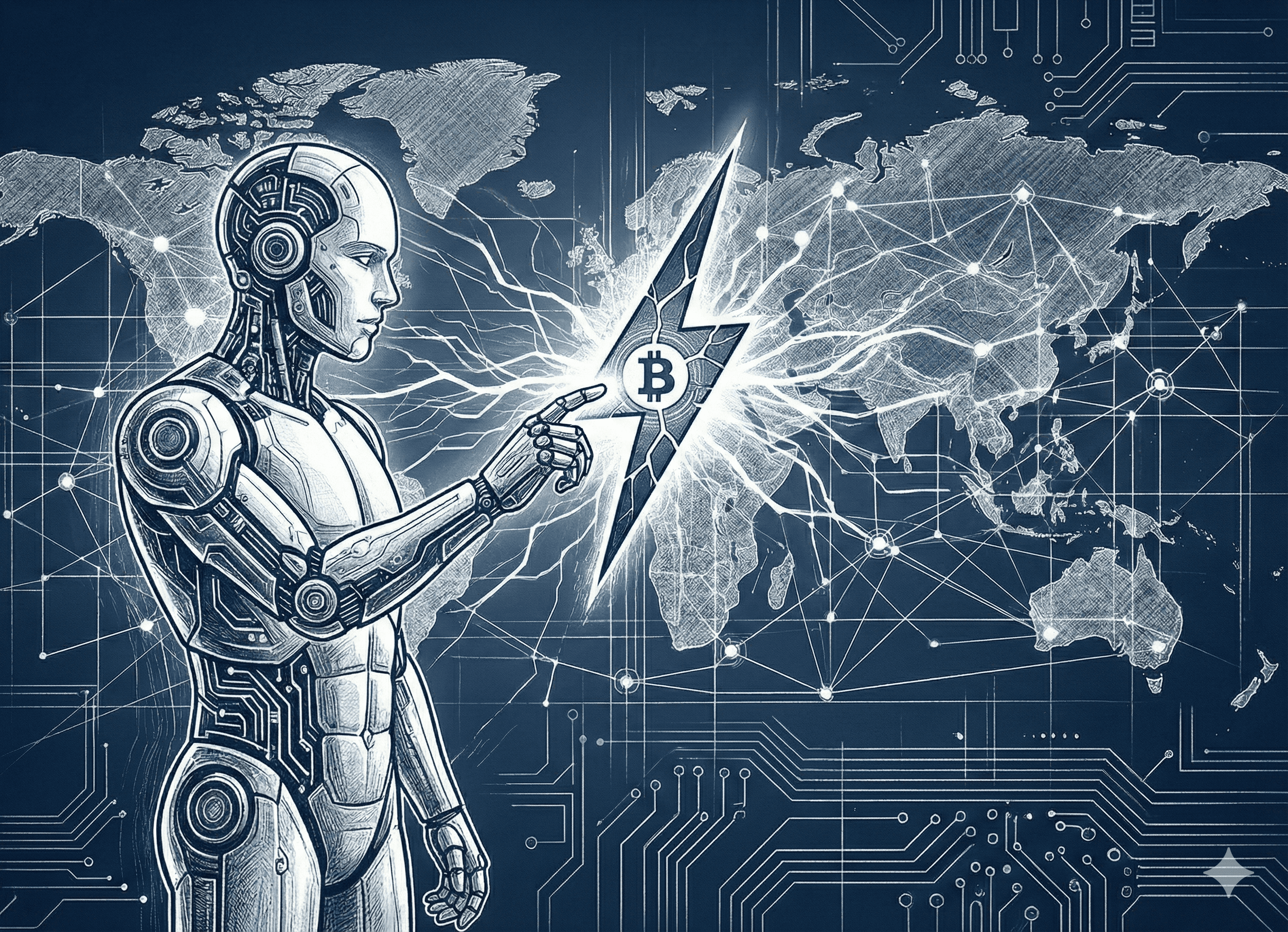
The Birth of the Non-Human Economic Actor
We are currently witnessing the birth of a new economic species: the AI Agent.
For the last decade, software was a tool humans used to do work. Software greatly aided in the facilitation of a task, but human input was still needed on most ends of the process in order for the work to be completed.
However, Large Language Models (LLMs) have shifted the paradigm. We are moving from software that facilitates, to agents that do.
In the very near future, you will not just ask an AI to write an itinerary for your trip to Tokyo. You will ask it to book the flights, negotiate the best rate for the hotel, hire a local guide, and pay for the reservations.
But here we hit a hard, invisible ceiling.
An AI agent cannot walk into a Chase bank branch and open an account. It has no passport. It has no utility bill to prove residence. It cannot pass a background check. The entire legacy financial system is built on a foundation of Identity (KYC/AML) and Permission. It is a system built by humans, for humans.
So, how does a digital entity participate in the economy?
It doesn’t use Visa. It doesn’t use Swift. It rejects the system that requires a heartbeat to operate. Instead, it naturally gravitates toward a system that is:
Permissionless (No ID required)
Digitally Native (Code, not paper)
Always On (24/7/365 uptime)
There is currently only one monetary network on Earth that meets those specific requirements.
Bitcoin is not just “digital gold” for humans anymore. It is the native currency of the Machine Age.
Why Fiat Fails the “Machine Speed” Test
To understand why AI rejects traditional finance (TradFi), we have to look at the unit economics of a transaction.
The traditional banking system is designed for Macropayments. It assumes you are buying a coffee ($5), a shirt ($50), or a car ($30,000). Because these amounts are relatively high, we tolerate the inefficiencies of the network.
But AI Agents won’t operate in the macro. They will operate in the micro.
Consider an autonomous agent tasked with researching a medical topic. It might need to read 5 paid articles, access 3 different datasets, and query a specialized API 50 times.
Using traditional payment rails, the agent would have to sign up for 5 different monthly subscriptions ($20/month each), enter credit card details for each, and cancel them 10 minutes later.
With Bitcoin, the agent can pay $0.004 for just the API calls it made, and $0.10 for just the articles it read.
The Math of Impossible Payments
To do micropayments like this is impossible with Visa or Mastercard.
Legacy payment processors (like Stripe or PayPal) have a fee structure that looks like this:
2.9% + $0.30 fixed fee per transaction
If an AI tries to send a payment of $0.05 (5 cents) using a credit card:
The cost to process the payment is $0.30.
The payment itself is $0.05.
Result: You lose money on every transaction.
This “Fixed Fee Floor” is the killer. It means that any transaction under $1.00 is economically unviable in the fiat world.
Speed: The Other Killer
Beyond cost, there is latency. AI agents operate in milliseconds. They negotiate compute power, data access, and storage in real-time.
An AI cannot wait for a bank wire to clear before it renders a frame of video. It needs money that is has the ability to “stream”. It needs a system where money moves as fast as data. If the money stops, the service stops instantly.
If the legacy system is a sluggish, high-fee toll road, AI agents are trying to drive Formula 1 cars on it. They need a racetrack.
The Solution: The Native Internet Money Stack
If AI agents cannot use the banking system, they need a system built for machines. As we established, this system must be permissionless (no ID), instant (milliseconds), and highly divisible (less than a cent).
We already have this. It is not a single tool, but a two-layer stack: Bitcoin (The Asset) and The Lightning Network (The Rail).
To understand why this is the inevitable choice for AI, we must distinguish between the money itself and the network that moves it.
Layer 1: Bitcoin (The Digital Gold)
First, the AI needs a currency that is neutral.
The Problem with fiat currencies (dollar/euro) is that fiat currencies are political tools. They are bound by jurisdiction. If an AI runs on a server in Singapore but does work for a user in Brazil, which currency does it hold? Which laws does it follow?
Bitcoin, on the other hand, is global, neutral, and apolitical. It is the only asset that is not someone else’s liability.
For an AI, holding Bitcoin is like holding physical gold because it is a bearer asset. If the AI possesses the private key, it possesses the value. There is no bank manager to freeze the funds because the AI’s algorithm seemed “suspicious.”
Layer 2: The Lightning Network (The High-Speed Rail)
Having established that Bitcoin is the “Digital Gold” in the vault, the Lightning Network is the high-speed rail line connecting the vaults.
Bitcoin’s base blockchain is slow by design (settling every 10 minutes). This is too slow for an AI that needs to make 50 decisions per second. The Lightning Network solves this by taking transactions off the main chain.
Just as we stream data (Netflix) or music (Spotify), the Lightning Network allows us to stream money.
Think of the internet. It works by breaking files into tiny “packets” of data, sending them across the world, and reassembling them. The Lightning Network does the same for value. It breaks money down into tiny packets (Satoshis) and routes them instantly.
This combination: Pristine Collateral (BTC) held on a High-Speed Network (Lightning), creates the first monetary system that operates at the speed of code.
The Missing Error Code: HTTP 402
Now we can see how this plugs into the web itself.
When the internet was built in the 90s, the engineers created error codes we all know:
404: Page Not Found
403: Forbidden
402: Payment Required
For 30 years, Error 402 has sat unused. The developers of the internet reserved it for a future digital cash system that didn’t exist yet. They knew credit cards (which require banks and identities) weren’t the native currency of the web.
Bitcoin has finally filled that void.
Enter the L402 Protocol
This is the technical standard that will run the machine economy. L402 (Lightning + HTTP 402) is a protocol that lets AI agents buy resources without ever creating an account or logging in.
Here is how the “Login” model compares to the “L402” model:
The Old Way (The Human Way):
Go to website.
Click “Sign Up.”
Enter email/password.
Enter credit card.
Buy a $20 monthly subscription.
Get an API Key.
The New Way (The Agent Way):
AI Agent requests data from an API.
Server replies: “HTTP 402 Payment Required: Pay 5 satoshis (approx $0.003).”
AI pays the Lightning invoice instantly.
Server sends back a “Macaroon” - a cryptographic token that acts as both the receipt and the key to unlock the data.
There is no account. There is no “User Profile.” The payment is the authentication.
Why This Changes Everything: The Stateless Web
This shift from asking “Who are you?” to simply asking “Did you pay?” does more than just speed things up. It fundamentally changes the architecture of the internet for the better.
First, it kills the data honeypot.
In the legacy web, every service you interact with has to build a fortress to protect your personal data - your email, your password, your credit card number. This is expensive for them and dangerous for you.
But with L402, the interaction becomes “stateless.” The server doesn’t need to know who the AI agent is, where it came from, or who owns it. It doesn’t need to store a single byte of personal data. It simply validates the cryptographic math on the Macaroon. If the math works, the door opens. Liability disappears, and privacy becomes the default.
This also creates a truly permissionless economy for builders.
Today, if a developer wants to monetize a new AI tool, they are immediately hit with the friction of the fiat world: incorporating a company, applying for Stripe, and blocking users from “restricted” countries.
In an L402 world, a 15-year-old coder in Nigeria or an anonymous developer in Japan can spin up an API and start accepting payments from AI agents globally, instantly. There are no forms to fill out, no banks to please, and no borders to worry about.
Finally, this creates a “Lego Block” economy.
AI agents are not employees; they are contractors that operate in milliseconds. They shouldn’t be forced into monthly subscriptions where they pay $20 for access they only use once.
L402 destroys these silos. It allows an agent to stitch together fifty different APIs, and paying a fraction of a penny to each, to solve a single complex problem. Instead of being locked into a contract, agents can dynamically hire the best tool for the job, second by second, paying only for the exact outcome they need.
Energy Money (The Physics of Value)
If L402 is the language AI speaks, we still have to answer a fundamental question: In what currency should an AI store its wealth?
You might assume an AI would be happy holding digital dollars (USDC) or a stablecoins. After all, they are stable and easy to budget. But this assumes AI cares about human stability. It doesn’t. AI cares about resources.
To understand this, we have to look at what an AI actually is.
At its most basic physical level, an AI is a machine that converts electricity into intelligence. Its entire existence is constrained by the cost and availability of energy (kWh).
Therefore, an AI has a simple economic imperative: It must maximize its ability to purchase future electricity.
This is where fiat currency fails. The US Dollar, the Euro, and even stablecoins are political abstractions. Their value is dictated by central banks, interest rates, and government debt.
Over time, they are designed to lose purchasing power, or put another way, to leak energy. For a machine that plans to operate for decades or centuries, holding a melting asset is a bug in the code.
Bitcoin, however, is different. It is the only money in the world that is not backed by “faith and credit,” but by Proof of Work. To create Bitcoin, you must expend real, physical energy. In this sense, Bitcoin is simply “stored electricity.”
This creates a perfect, closed thermodynamic loop for the AI economy. The AI consumes electricity to perform a task. It gets paid in Bitcoin (stored electricity). It holds that Bitcoin as pristine collateral, knowing that the math secures it, not a politician. And when it needs to work again, it spends that Bitcoin to buy more electricity.
As Arthur Hayes has argued, this aligns the monetary interests of the AI with the physical laws of the universe. An AI doesn’t need a bank account; it needs a battery. And Bitcoin is the best battery ever invented.
The Counter-Argument: Why Not Stablecoins or Altcoins?
At this point, a reasonable critic might ask: “I agree that AI needs digital money. But why use volatile Bitcoin? Why not use USDC (Stablecoins) for stability, or Solana for high speed?”
It is a fair question. To an AI, however, these alternatives present fatal “bugs” that Bitcoin does not.
1. The Stablecoin Trap (USDC/USDT)
You might think an AI would prefer Stablecoins because they are easy to budget. But Stablecoins are not money; they are digital IOUs. They rely on a central company (like Circle or Tether) keeping dollars in a traditional bank.
One problem this presents is that centralized issuers can freeze addresses instantly. If an AI agent executes a trade that a regulator dislikes, or interacts with a blacklisted wallet, the issuer can brick the AI’s entire treasury with one command.
Another problem is that it introduces counter party risk. Stablecoins inherit the risks of the legacy banking system. If the bank holding the reserves fails (like Silicon Valley Bank), the AI’s purchasing power vanishes. For an autonomous agent, holding a Stablecoin is like being an employee. Holding Bitcoin is like being a sovereign.
2. The Altcoin Trap (Ethereum/Solana)
Next, one may ask “Ok, so if stablecoins are not the option why not use a “high-performance” chain like Solana or a smart-contract layer like Ethereum?”
Well. firstly, AI agents require 100% reliability. High-throughput chains often achieve speed by sacrificing decentralization or stability (e.g., historical network restarts). An AI cannot risk its financial rail going offline during a critical negotiation.
Secondly, these alt coins introduce monetary policy risk. Bitcoin’s monetary policy is “ossified” meaning that it is fixed by math and hasn’t changed. Other chains frequently alter their inflation rates, staking yields, or burn mechanisms via governance votes.
An AI can predict Bitcoin’s supply in the year 2140. It cannot predict the governance decisions of a DAO next year. AI trusts code consistency over human governance.
The Verdict: Permission vs. Physics
Ultimately, the choice comes down to the difference between “Guest Access” and “Root Access.”
While stablecoins offer familiarity and altcoins offer features, they both rely on human intermediaries and malleable governance that can revoke an agent’s funds at any moment.
For an autonomous entity, censorship resistance is not a luxury, it is a survival requirement. Bitcoin is the only protocol that grants true sovereignty, ensuring the agent is not just a user with permission to transact, but a permanent economic actor that cannot be turned off.
The World We Are Building: The Machine Economy
So, if we give AI agents a wallet (Bitcoin), a payment rail (Lightning), and a language (L402), what actually happens? We move from an economy dominated by huge subscriptions and walled gardens to a fluid, high-speed marketplace of “Lego blocks.”
Imagine a world where you don’t buy a subscription to the New York Times, Wall Street Journal, and Bloomberg. Instead, your personal AI agent acts as your curator. When you ask it to “summarize the news on Apple stock,” it autonomously visits ten different premium news sites, pays 3 cents here and 5 cents there to unlock specific paragraphs, and synthesizes the answer for you. The publishers get paid instantly for their value, and you get exactly what you needed without managing a dozen passwords.
We will see this explode in the world of computing power.
Right now, if you want to train an AI model, you are likely renting a massive server from Amazon or Google, paying by the hour even if you only use it for minutes. In the machine economy, agents will bid on compute power second-by-second.
An agent needing to render a video could spot a gaming PC in South Korea that is sitting idle, rent its GPU for 45 seconds, pay the owner a few satoshis, and move on.
This creates a global, decentralized supercomputer where no resource is wasted.
But perhaps the most immediate impact will be on the problem that plagues us all: Spam.
Today, email and social media are free to send, which means spam is infinite. If it costs $0.00 to send a million phishing emails, scammers will send a billion. But in an L402 world, your AI inbox could have a simple rule: “If you are not in my contacts, you must attach a payment of 10 satoshis (a fraction of a penny) to deliver this message.”
For a real human or a legitimate business, that cost is negligible. But for a spammer trying to email ten million people, that tiny fee makes the attack economically impossible. We solve spam not by filtering it, but by pricing it.
Conclusion: The Agent-to-Agent (A2A) Future
I believe we are standing on the precipice of a shift as large as the industrial revolution. For centuries, the economy has been Human-to-Human (H2H), Business-to-Consumer (B2C) and Business-to-Business (B2B).
But I believe the largest volume of economic activity in the next decade will not involve humans at all. It will be Agent-to-Agent (A2A).
Machines will trade data, compute, and energy with each other at speeds and volumes that humans cannot comprehend. They will negotiate, settle, and audit transactions in milliseconds. To participate in this economy, they will need a money that is native to their environment and is neutral, digital, and energy-backed.
They won’t ask for permission to open a bank account. They will just download the code. Bitcoin isn’t just a speculative asset for your portfolio; it is the inevitable currency of the machine age.