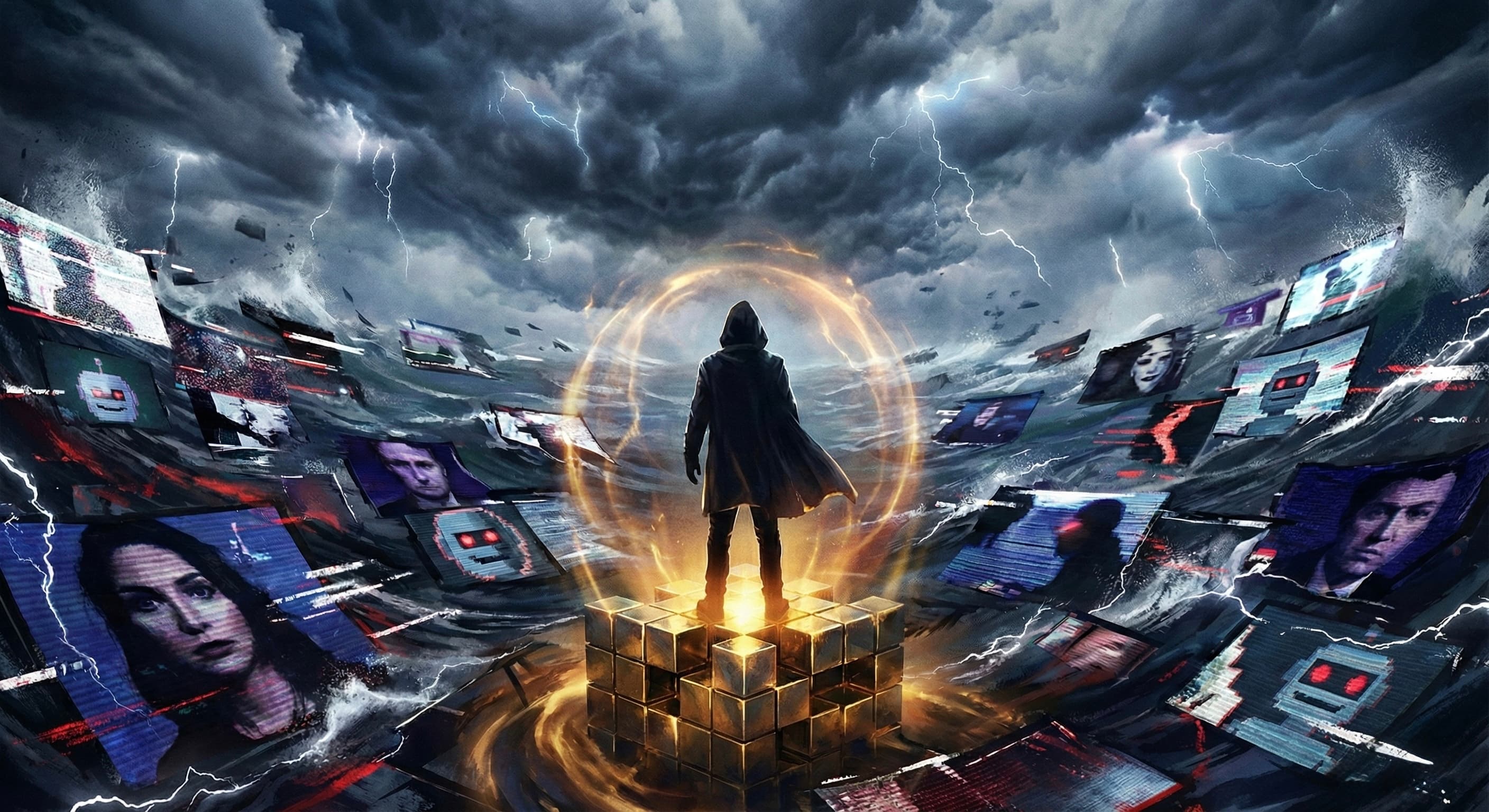
Section I: The 51% Tipping Point
You’ve probably noticed something feels off about the internet lately.
Not in any single dramatic way. It’s more like a slow drift. The comments don’t feel quite right. The replies come too fast, say too little, or seem weirdly off-topic. You post something and the engagement feels hollow, like shouting into a room full of mannequins. You scroll through what should be a conversation and realize you’re not sure how many actual people are participating.
You’re not imagining it.
Late last year, Imperva (a cybersecurity firm that’s been tracking this for over a decade) released their annual bot report. The finding that made headlines: for the first time in history, automated traffic has overtaken humans. Bots now account for 51% of all web activity. The malicious ones specifically have climbed to 37%, up from 32% the year before.
We’ve crossed a threshold. Most of the traffic isn’t us anymore. It’s them.
The Deafening Noise
Remember what the internet felt like ten years ago? It was a town square. Messy and loud, sure, but when you shouted, a human shouted back.
Today we’re still standing in that square, but we’re being drowned out. We haven’t left yet. We’re just suffocating.
When you tweet an opinion hoping for debate, you get swarmed. A couple of engagement farming bots try to sell you a scam, an AI summarizes your post for some dashboard somewhere, and a political bot auto-replies with outrage bait. You try to read the comments on Instagram to see what people actually think, but the top fifty comments are generic AI-generated hype loops (”This is fire! 🔥”). You have to scroll for minutes just to find a heartbeat.
This is annoying. But annoyance isn’t the real problem.
The real problem is what’s hiding inside all that noise.
The Collapse of Seeing is Believing
For all of human history, we had a rough but workable rule: if you saw it with your own eyes, it was probably real. Video was evidence. Audio was proof. A photograph could end a career or start a revolution because we trusted that it captured something that actually happened.
That rule is dead.
A year ago, generating a convincing deepfake required expensive software, technical skill, and hours of processing time. Today you can do it from your phone during your lunch break. The cost has collapsed to essentially zero, and the quality has gotten good enough to fool your mother, your boss, and maybe even you.
Think about what that means in practice. A video surfaces of a politician taking a bribe. Is it real? A voice memo leaks of a CEO saying something racist. Was it fabricated? Your uncle shares a clip of a world leader declaring war. Did it actually happen, or did someone generate it in fifteen minutes to see what would go viral?
We don’t know anymore. And increasingly, we can’t know.
This is the part that should unsettle you. The bot traffic is annoying. The deepfakes are existential. Because once you can fake anything, you can deny everything. Every real piece of evidence becomes dismissable as “probably AI.” Every genuine moment becomes suspect. We’re not just drowning in fake content. We’re losing the ability to point at something and agree that it happened.
Philosophers have a term for the baseline assumptions that let a society function: shared reality. It’s the idea that even when we disagree about politics or values, we at least agree on basic facts. The sky is blue. That video shows what it shows. This event occurred.
Shared reality is what lets strangers cooperate. It’s what makes journalism possible, courts functional, democracy coherent. And it’s slipping away from us faster than most people realize.
The Dark Forest Encroaches
In Liu Cixin’s sci-fi masterpiece The Three-Body Problem, he describes the universe as a Dark Forest, a place where survival depends on silence because the predators are listening.
We aren’t quite silent yet, but we’re learning to be. Most people are still fighting a losing war on the open timeline, posting and hoping for the best. But the smart money (and the smart social capital) is starting to drift away. They’re moving into cozy web enclaves: encrypted Signal chats, gated Discords, private forums where you have to know someone to get in.
They’re realizing that the open web is becoming a hunter-killer zone. Every public post is bait for a phishing agent. Every public photo is training data for a deepfake model. Every opinion you share can be cloned, twisted, and deployed against you by a bot that never sleeps.
The internet isn’t dead. It’s just becoming uninhabitable. The noise is getting louder, the fakes are getting better, and the ground we used to stand on is turning to quicksand.
So what do we do?
The obvious answer is to demand that someone fix it. Surely the platforms can solve this. Surely the government can step in. Surely there’s some authority that can restore order and tell us what’s real again.
That instinct is understandable. It’s also a trap.
Section II: The Trap
If the problem were just spam, we could learn to ignore it. But the problem isn’t noise. It’s trust.
And when trust collapses, people look for someone to restore it.
The Zero-Trust Crisis
Here’s what the collapse of shared reality looks like in practice. A scandalous video surfaces. Half the country believes it’s real. Half dismisses it as a deepfake. And here’s the thing: both responses are now equally rational. You genuinely can’t tell anymore. Nobody can.
So what happens when you can no longer trust the artifact itself? When the video, the audio, the screenshot could all be fabricated?
You’re forced to trust the authority instead. You stop asking “is this real?” and start asking “who’s telling me it’s real?” The platform. The outlet. The institution. If they say it’s verified, maybe you believe them. If they say it’s fake, maybe you believe that too.
This is the shift happening beneath our feet. We’re moving from a world where evidence spoke for itself to a world where evidence requires an endorsement. And whoever controls the endorsement controls reality.
The False Promise of Verification
Governments and Big Tech companies see this crisis clearly. And they’re racing to position themselves as the solution.
Their answer? Digital IDs. Content credentials. Verification standards like C2PA that stamp media files with cryptographic seals of authenticity. They want to be the arbiters of truth. They want you to trust their servers, their timestamps, their little blue checkmarks.
On the surface, this sounds reasonable. Someone has to verify what’s real, right? In a world of infinite fakes, don’t we need a trusted authority to sort signal from noise?
But think carefully about what you’re being asked to accept.
If the only way to know whether something is true is to ask a centralized authority, then the owner of that authority becomes the gatekeeper of reality. Whatever they bless is real. Whatever they reject is fake. Whatever they choose not to verify simply doesn’t exist in the official record.
Today’s trusted institution is tomorrow’s propaganda ministry. The verification checkmark that protects you this year can be weaponized against you next year. We’ve already seen platforms selectively enforce “misinformation” policies. We’ve already seen governments pressure companies to suppress stories that turned out to be true. This isn’t paranoia. It’s recent history.
And there’s a deeper problem. Centralized systems have a single point of failure. They can be hacked. They can be coerced. They can be quietly edited by whoever holds the keys. If a government decides that a certain video never happened, they don’t need to destroy every copy. They just need to revoke its verification. In the eyes of the official record, it becomes a deepfake by decree.
The Trap
This is the trap we’re walking into.
The crisis is real: we genuinely are losing the ability to trust digital information. And the proposed solution makes it worse: we’re being asked to trade one vulnerability (anyone can lie) for another (one entity decides what’s true).
The first problem is chaos. The second problem is control. Neither is acceptable.
We don’t need a trusted authority to tell us what’s real. We need something else entirely. We need a way to anchor digital information to physical reality without asking anyone’s permission.
To understand what that might look like, we have to think about something that seems unrelated: the cost of lying.
Section III: Truth Requires Cost
Here’s a question that sounds philosophical but turns out to be practical: why is lying suddenly so effective?
The obvious answer is that AI got good. But that’s not quite right. AI got cheap. And that’s a different thing entirely.
The Economics of Deception
In the physical world, lies have always been expensive. If someone wanted to frame you for a crime in 1995, they’d need to hire actors, rent a location, shoot on film, and edit the footage. It would cost thousands of dollars and require a conspiracy of people willing to stay quiet. The expense didn’t make lying impossible, but it created friction. It meant that most lies weren’t worth telling because the cost exceeded the benefit.
The internet eliminated some of that friction, but not all of it. Even five years ago, creating a convincing fake video required specialized software, technical expertise, and hours of rendering time. There was still a cost. It was lower than before, but it wasn’t zero.
Now it’s zero.
A three-second voice clip can clone someone’s vocal cords. A single photo can generate a video of that person saying anything. The tools are free, the processing is instant, and the results are good enough to fool most people most of the time.
This is an economic shift, not just a technological one. When the cost of producing a lie drops to zero, the supply of lies becomes infinite. We’re not drowning in deepfakes because AI is powerful. We’re drowning because AI is cheap.
The Principle
This suggests something important: the antidote to cheap lies might be expensive truth.
Not expensive in the sense of paywalls or subscriptions. Expensive in a more fundamental sense. Expensive meaning: costly to produce, difficult to fake, anchored to something that can’t be conjured from nothing.
Think about what makes physical evidence trustworthy. A fingerprint at a crime scene works because you can’t fake having been somewhere you weren’t. The fingerprint is tied to a physical body that had to actually be present. The evidence has weight because presence has cost.
Digital information has no weight. A file can be created, copied, modified, backdated, all without any physical constraint. There’s no friction. Which is why it’s becoming worthless as evidence of anything.
So what would it look like to add weight back to digital information? To create something digital that’s genuinely costly to produce, and therefore genuinely difficult to fake?
This brings us to Bitcoin.
The Heaviest Digital Object
Most people think of Bitcoin as digital money. But that description misses what makes it strange.
Everything else digital is weightless. An image, a video, a document can be copied infinitely at no cost. That’s what digital means. The copy is identical to the original and creating it costs nothing.
Bitcoin is different. Each bitcoin is the product of real energy expenditure. To create new bitcoin, miners around the world run specialized hardware that consumes massive amounts of electricity. This isn’t a flaw or a waste. It’s the entire point. The energy cost is what makes each coin scarce, and scarcity is what makes it impossible to counterfeit.
You cannot fake a bitcoin because faking it would require actually doing the work. The energy is the proof.
This makes Bitcoin the only digital object that’s heavy. Not physically heavy, obviously. But economically heavy. It has weight because it costs something to exist. And that weight is what makes it trustworthy in a way that other digital things aren’t.
The Only Honest Clock
There’s another property of Bitcoin that matters here: time.
In the digital world, time is just a number in a database. A server admin can set their clock to any date they want. A file’s creation timestamp can be edited after the fact. There’s no way to prove when something really happened because “when” is just metadata, and metadata can be changed.
Bitcoin solves this in an unexpected way. Every ten minutes, a new block gets added to the chain. Each block requires enormous energy to produce and references the block before it. You cannot insert a fake block into the past without redoing all the work that came after it, which would cost billions of dollars and require overpowering the entire global network.
This means Bitcoin functions as a clock that can’t be edited. The sequence of blocks is a timeline anchored to physical reality. If something is recorded in block 900,000, you know it existed at the moment that block was mined. Not before. Not later. Right then.
In a digital world where timestamps can be fabricated, this is the only clock that tells the truth. Not because we’ve decided to trust it, but because the physics make lying prohibitively expensive.
Section IV: Money and Truth
At this point you might be thinking: okay, Bitcoin is interesting, but what does sound money have to do with deepfakes and dying trust in the internet?
More than you’d expect. Money and truth turn out to be the same problem wearing different masks.
What Money Actually Is
We usually think of money as a tool for buying things. But beneath that surface function, money is really a record. It’s a ledger of who contributed what to whom. When you earn money, you’re recording that you provided value to someone. When you spend it, you’re transferring that record to someone else.
This is why counterfeiting is such a serious crime. It’s not just theft. It’s lying. A counterfeiter creates a false record that claims value was contributed when it wasn’t. They’re inserting fiction into a system that only works if it tells the truth.
For most of history, we solved the counterfeiting problem by making money out of something costly to produce. Gold works as money not because it’s pretty but because you can’t fake having mined it. The weight of a gold coin is proof of work. The cost is the verification.
Paper money divorced the record from the physical cost, which is why it requires trusted institutions to prevent counterfeiting. We have to trust the central bank not to print too much, not to inflate away value, not to lie about how much money exists. Sometimes that trust is justified. Often it isn’t.
Bitcoin returns to the older principle. Each coin represents provable energy expenditure. You can’t counterfeit it because counterfeiting would require actually doing the work. The cost is built in.
Sound Money, Sound Truth
Here’s the connection to our crisis of truth.
Sound money is money that can’t be cheaply faked. Sound truth is information that can’t be cheaply faked. Both require the same thing: a cost that makes forgery uneconomical.
The deepfake crisis exists because we’ve separated information from cost. A video used to require cameras, crews, editing bays. Now it requires a text prompt. The marginal cost of producing fake information has dropped to zero, so the supply has become infinite.
Bitcoin represents the opposite principle. It’s information that cannot be separated from cost. The energy expenditure is the proof. The scarcity is real. The record can’t be edited because editing it would require re-spending resources that have already been consumed.
This is why Bitcoin matters beyond finance. It’s the only demonstration we have that digital information can be made heavy. That you can create something online that has the trustworthiness properties of physical objects. That cost can be embedded into data in a way that makes lying expensive again.
The Bedrock
Think about what it means to own bitcoin.
You’re not holding an entry in someone else’s database. You’re not trusting a bank or a platform or a government to honor your claim. You’re holding a key to something that required real-world resources to create and would require real-world resources to fake.
In a digital world where everything else is becoming fluid, where voices can be cloned, images fabricated, histories rewritten, Bitcoin is solid. Not because anyone decided it should be. Because the thermodynamics require it to be.
The same wall of energy that prevents someone from counterfeiting your coins prevents them from rewriting the record of what happened and when. The security model that protects your wealth also protects truth.
This is the deeper significance that most Bitcoin commentary misses. For fifteen years, people have asked what the intrinsic value of Bitcoin is. The early answers were about payments, remittances, banking the unbanked. Those applications are real, but they were never the full picture.
In 2026, the answer is clearer. The intrinsic value of Bitcoin is that it’s real. In an increasingly synthetic world, that turns out to be worth more than anyone expected.
Section V: Signal in the Noise
We have to be honest with ourselves. We are never going back to the old internet.
We cannot ban the bots. We cannot un-invent the AI models. The cost of generating noise will stay at zero forever. The Dark Forest isn’t a temporary condition we’re passing through. It’s the new environment.
But that doesn’t mean we have to drown.
The Split
What’s emerging is a divergence. Two different relationships with digital information, based on two different assumptions about what can be trusted.
One path accepts that most digital content is now noise. You engage with the feeds, the timelines, the endless scroll, but you hold it loosely. You assume that anything could be fake, that engagement metrics are gamed, that the comments might be bots, that the video might be generated. You participate because it’s entertaining or useful, but you don’t mistake it for reality. This is where most of online life will happen: fast, cheap, abundant, and weightless.
The other path seeks weight. When something actually matters, when you need to verify that something is true, when you’re making a decision that has consequences, you look for cost. You ask: what was sacrificed to produce this? What skin is in the game? What can’t be faked?
These aren’t two separate internets. They’re two different modes of engaging with the same space. The skill we’re all going to have to develop is knowing when we’re in which mode.
The Filter of Cost
In a world of infinite noise, cost becomes the filter.
This is already happening, even if people don’t articulate it this way. When someone puts their name and reputation on a claim, that’s a cost. When a company stakes its business on a product, that’s a cost. When a person shows up physically, that’s a cost. We instinctively trust these signals more than anonymous assertions precisely because something was risked.
Bitcoin is the purest digital expression of this principle. It’s provable cost, recorded permanently, outside anyone’s control. But the principle extends beyond Bitcoin.
The question to start asking about any piece of information is: what did it cost to produce? If the answer is “essentially nothing,” that tells you something. It doesn’t mean it’s false, but it means the filter that would have prevented it from being false isn’t there. If the answer is “a lot,” that’s not proof of truth either, but it’s a signal. It’s weight.
The Golden Anchor
So the next time someone tells you Bitcoin is imaginary money, consider that they might have it exactly backwards.
The dollars in your bank account are entries in a database that can be edited, frozen, or inflated by whoever controls the server. The video on your screen is pixels that can be generated by anyone with a laptop and an afternoon. The email in your inbox is text that can be synthesized by anyone who’s heard your colleague speak for a few seconds. The timestamps on your files are metadata that can be set to any date someone chooses.
These things feel real because we’re used to trusting them. But that trust is a habit from an era when faking them was expensive. That era is over.
Bitcoin is the one thing in the digital realm that remains anchored. Not because we’ve collectively decided to trust it. Not because an institution vouches for it. Because the physics require energy to be spent, and that energy cannot be unspent. The past is locked. The record is real. The weight is there.
In a storm of infinite lies, that’s not just valuable.
It might be the most valuable thing there is.